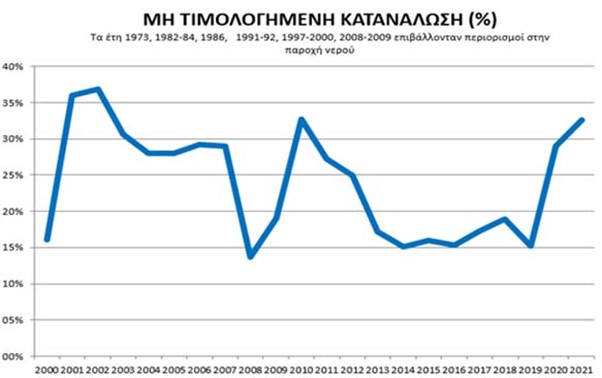

Part of the water supplied to the network was not recorded by consumers’ water meters due to inaccuracies, incorrect meter readings and other related causes, or due to losses. These losses are mainly attributed to leaks that could not be detected in time or damage caused to the network by third parties. The percentage of unbilled water increased sharply after the lifting of water supply restrictions in early 2010, as during the period of cuts the network remained empty for long periods (36 hours every 48 hours) and water pressure in the network was lower than usual. As a result, leaks indicating network faults did not surface. At the same time, the prevailing conditions during that period inevitably disrupted the systematic monitoring and detection of hidden leaks, as well as the Service’s efforts to further reduce unbilled water, which is one of the Council’s main objectives.
With the restoration of continuous water supply, the Service initiated a persistent and intensive effort to significantly reduce this percentage, using modern electro-acoustic equipment to detect hidden leaks and replacing faulty and old water meters to improve the accuracy of consumption recording. This effort yielded excellent results, as the percentage of unbilled water was reduced and maintained between 15% and 20% up to 2019.
In 2020, the ownership of the water supply network of Aradippou Municipality was transferred to the Larnaka Water Supply Council, resulting in a significant increase in the overall percentage of unbilled water, reaching 29% in 2020 and 32.5% in 2021. This increase is mainly due to the numerous issues within the Aradippou network, which lead to unbilled water levels of approximately 55–60%. A similar percentage of unbilled water is also observed in the network of Livadia Municipality, which was incorporated into the Larnaka Water Supply Council in 2022, amounting to approximately 50%.
In 2021, the percentage of unbilled water within the Larnaka areas reached approximately 21%. This increase is partly due to a slight rise in unbilled water in the older Larnaka areas that were supplied by the Larnaka Water Supply Council prior to the inclusion of Aradippou Municipality, but mainly due to the fact that certain areas of Aradippou, which exhibit significantly higher unbilled water levels, are now supplied through the Larnaka Municipality network. Additionally, discrepancies continue to exist in water measurements at the inlet and outlet of reservoirs due to inaccuracies in the Water Development Department meters at reservoir inlets. This issue is expected to be resolved following their replacement as part of the project for the construction of the new reservoir.
To address the multiple network issues in the Aradippou area, a strategic plan and action framework have been prepared by the Technical Services of the Larnaka Water Supply Council, adopting best practices for water supply network management in the short, medium and long term.
During the first phase (2020–2021), serious issues related to insufficient water supply in specific areas of Aradippou were addressed by integrating them into and supplying them from the Larnaka water supply network. In addition, the remaining network of the Aradippou area was divided into enclosed supply zones fed from a single point (zone heads).
Other important actions that have been initiated or are under implementation include valve inspections and installation of new ones where necessary, installation of new pipelines or replacement of old ones, replacement of all domestic water meters with smart meters enabling real-time monitoring, installation of telemetry and telecontrol systems at zone heads, deployment of noise loggers with correlation capability for leak detection, and the development of central transmission infrastructure and a new reservoir in the near future.